
10 Reasons Digital eCards Beat Paper Cards for Groups
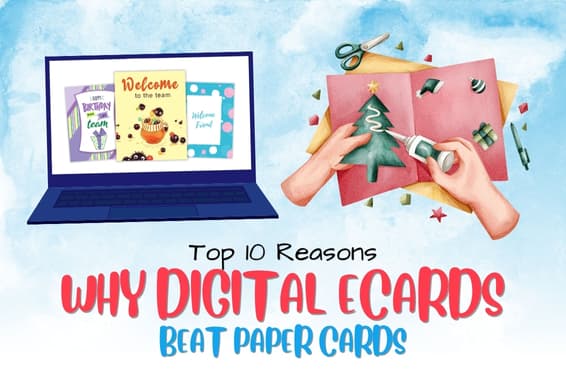
The card went round the office on a Tuesday. By Thursday it had six signatures, three of them just a first name, and it was sitting under a pile of paper on someone's desk while the person it was for wondered whether anyone had remembered.
That is the paper card at work, and most people reading this have watched it happen. Someone buys the card, someone else is put in charge of walking it around, and the whole thing depends on twenty people being in the building on the same three days. Two are on leave. One works from home Tuesdays. One is at a client site all week. The card that arrives is not a message from the team — it is a message from whoever happened to be at their desk.
Below are ten things a digital card does that paper cannot, and at the end, the two things paper still does better. For the balanced version of that trade-off, we have written a full paper versus digital comparison separately.
1. Everyone Signs, Wherever They Are
This is the one that matters most, and everything else on this list is secondary to it.
A paper card has to be physically reached. A card at a link does not. The people who miss out on a paper card are always the same people:
- Anyone on leave that week
- Anyone working from home that day
- Anyone at a client site, in another office, or travelling
- Anyone on a different shift
- Anyone who was in a meeting when it came past their desk
None of them are missing because they did not care. They are missing because the card was in one place and they were not. Remove that requirement and participation roughly doubles — and if your team is spread across regions, our guide to scheduling across time zones covers how to time it so nobody is asleep when the link goes out.
2. Nobody Has to Carry It Around
The person who volunteers to walk a paper card around the office is doing a genuinely annoying job. They have to remember who has signed, catch people between meetings, keep it hidden from the recipient, and chase the last four stragglers.
With a link, that job disappears. One message in a channel, and everyone signs on their own time. The organiser goes from courier to someone who sent one message.
3. The Cost Stops Mattering Past About Ten Cards
A single paper card is cheap enough not to think about. A hundred is not.
Run the numbers for an HR team marking every employee birthday:
- A card: roughly £3 to £6 each
- Postage: more again if anyone is remote
- Time: an afternoon of buying, addressing and posting
- Repeat: every month, forever
Digital removes all four lines. The two-hundredth card costs what the second one did, and for companies running this at scale, bulk and automated sending turns a recurring afternoon into a one-time setup.
4. It Arrives on the Day
Paper requires you to be right about two things: when you post it, and whether the postal service agrees with you. Get either wrong and the card arrives after the occasion, which reads as an apology rather than a greeting.
A digital card sent on the day arrives on the day. It can also be scheduled weeks ahead and delivered at 9am on the right morning, which is the version most people actually want — decide early, arrive on time.
5. Distance Stops Being a Problem
No address required, nothing lost in transit, no international postage, no customs. For a colleague who moved abroad, a relative in another country, or a team split across three offices, this is not a convenience — it is the difference between sending something and not.
Our piece on why remote teams need group cards goes further into what changes when nobody shares a building.
6. It Can Carry More Than Words
An envelope holds paper. A digital card holds:
- Photos — from the team trip, the first day, the project that nearly failed
- GIFs — which do a job that a written joke often does not
- Video — thirty seconds from someone who could not be there
- Voice notes — for the people who write badly and speak well
That last group is larger than most organisers expect. Plenty of people who freeze at a blank message box will happily record twenty seconds. Our guide to adding media to group cards covers what actually gets used.
7. It Does Not Get Lost
A paper card can go missing at four points: before it is signed, while it is being carried around, in the post, or during a house move five years later.
A digital card sits at an address indefinitely. The recipient can reopen it on a bad day in three years, from a phone, without having kept anything.
8. Nobody Runs Out of Room
The last four people to sign a paper card get the margins. There is a visible hierarchy in a paper card — whoever signed first got space to write something real, and whoever signed last got a corner.
A digital card gives every contributor the same room. The person who signs nineteenth writes as much as the person who signed first, which changes what the recipient actually reads.
9. It Works for Occasions Paper Never Reaches
Because it takes two minutes instead of an afternoon, digital gets used for the moments a paper card is too much effort for:
- Passing probation
- Coming back from parental leave
- Finishing a qualification
- A project that landed
- A hard week that somebody carried
These are the cards people remember, precisely because nothing forced them. If you want to build them into a rhythm rather than remembering ad hoc, our yearly group card calendar is the practical version.
10. It Can Become Something Physical Anyway
The last advantage is that digital does not close the door on paper.
Our premium group cards can be downloaded as a PDF after delivery and printed, which suits retirements, milestone birthdays and long-service farewells — occasions where twenty people need to sign remotely but the recipient will also want something to keep. To be clear: every card on our site is digital, and PDF download is a premium feature rather than a free one.
The Two Things Paper Still Does Better
An article arguing one side is only worth reading if it admits the other exists.
Handwriting. A card in someone's actual handwriting carries something no font reproduces, and the reason is effort — handwriting is slow, unfixable, and unmistakably theirs. If one person is writing to one person they know well, paper wins and it is not close.
Physical presence. A card on a desk gets seen forty times in a week. A digital card is opened once unless the recipient deliberately saves it. That is a real structural weakness, and printing a PDF only closes it if somebody actually prints one.
Both of those advantages belong to one person writing to one person. Neither survives contact with twenty contributors across three offices — which is the situation this whole article is about.
Where to Start
The occasions where the difference is most obvious are the ones with the most signers:
- Coworker birthdays — the most frequent, and the one paper handles worst
- Farewells — where people write the most and need the most time
- Retirements — forty years, and the contributors include people who left the company
- Get well messages — where one card beats forty separate texts
You can start a free group card in about a minute.
Frequently Asked Questions
Are digital cards better than paper cards?
For anything involving more than a few signers, yes — a paper card only reaches people who can physically get to it, so the ones on leave, working from home or in another office are excluded by logistics rather than choice. For one person writing to one person they know well, paper is often better, because handwriting carries effort that a screen cannot reproduce.
How much do you save switching from paper to digital cards?
The saving only becomes significant past about ten cards. A single paper card costs a few pounds and is not worth calculating; a hundred cards a year plus postage plus the time spent buying and addressing them is a real budget line. Digital cost stays flat regardless of how many you send.
Can a digital card be printed?
Our premium group cards can be downloaded as a PDF after delivery and printed. That is worth doing for milestones, since it closes the main weakness of digital — a card that exists only at a link is usually opened once, while a printed one sits somewhere and gets seen repeatedly.
Do more people sign a digital card than a paper one?
Generally yes, and the reason is access rather than enthusiasm. A paper card is limited to whoever passes the desk during the three days it circulates. A link reaches everyone at once, including people who are travelling, remote or on leave — which on most teams is a meaningful share.
How far ahead should you open a group card?
Forty-eight hours minimum, and a week if your team is spread across time zones. Most half-signed cards were not ignored; the link simply went out when part of the team was asleep or away, and nobody came back to it. Two weeks is right for a farewell, where people need time to write something real.
Is a digital card impersonal?
It can be, and so can a paper one. What creates the impression of effort is the message, not the format — a shop-bought paper card signed with just a name reads as more impersonal than a digital card containing one specific memory. Format decides the logistics. Specificity decides the feeling.