
The Digital Card Revolution: How One Card Got Twenty Signatures
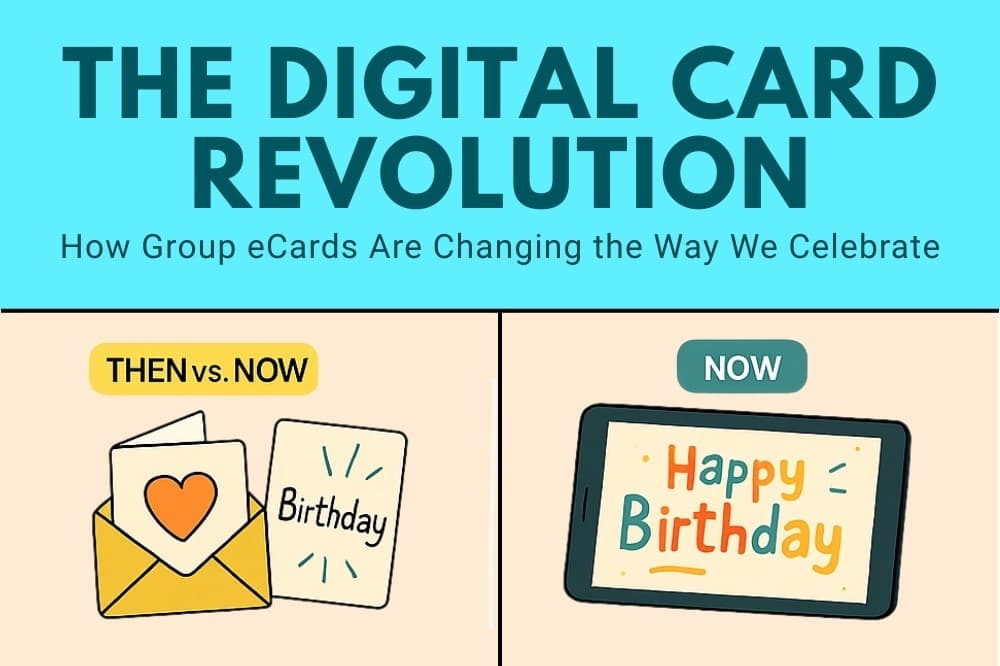
Everyone frames the change in greeting cards as paper going digital. Screens replaced envelopes, email replaced postage, and the card became free. That is true, and it is also the least interesting part of what happened.
The real shift is that the card stopped having one sender. A paper card is signed by one person, or passed hand to hand around a room until it runs out of space or somebody forgets to pass it on. A group card is signed by twenty people across four time zones who never occupy the same room, and it arrives as one object rather than twenty. That is not a format upgrade. It is a different thing entirely — and it happened because of a technical decision made in a research lab in 1994 that nobody at the time understood the consequences of.
Before Digital: Six Centuries of One Signature
The greeting card is older than most people assume, and for almost all of its history it worked exactly one way.
The oldest surviving Valentine written in English dates to 1477 — a letter from Margery Brews to her fiancé John Paston, part of the Paston family correspondence. Printed cards followed much later. Picture postcards appeared in Austria around 1869, which is when card design as a commercial idea really begins. In 1910, the Hall brothers — who would later become Hallmark — introduced the folded card, the format still on shelves today. Photographic greeting cards arrived in the 1960s.
Six centuries, and the model never changed: one person buys a card, one person writes in it, one person sends it. The office birthday card passed around the desks was the only collective version, and it worked badly — it ran out of room, it got lost on somebody's desk, and whoever was on leave that week simply did not sign.
1994: The Invention That Actually Mattered
In late 1994, a researcher named Judith Donath created The Electric Postcard at the MIT Media Lab. It was the first postcard site on the web. Users picked an image, added a message, and the recipient got it by email.
Except they did not get it by email. And this is the part that matters.
Mail servers in 1994 could not reliably handle image attachments, so Donath's system sent the recipient a coded link back to the publisher's website, where the card itself lived. The email carried an address, not a card.
That workaround — a technical compromise forced by the limits of 1994 infrastructure — became the defining architecture of the entire industry. Wikipedia notes that this delivery mechanism remained essentially unchanged until 2019. Every eCard you have ever received worked this way.
And it is the reason group cards exist.
Why the Link Changed Everything
A paper card is a physical object in one place at one time. To sign it, you have to be where it is. That single constraint is what limited every collective card for six hundred years.
A card that lives at a URL has no such limit. It exists in one place that everyone can reach simultaneously. Twenty people can open it, add a message, and close it again without the card ever moving — and crucially, without any of them needing to be near each other or awake at the same time.
Nobody designed that. Donath was solving an attachment-size problem. But the consequence of storing the card on a server rather than sending it as a file is that the card became addressable rather than transferable, and an addressable card can have as many authors as you can share a link with.
That is the actual revolution. Not that cards got cheaper or greener — those are real and well covered elsewhere, including in our own comparison of paper and digital cards. The revolution is that the card stopped being a single-author object.
What Came After
Late 1990s. Other companies built their own versions. Flash animation and background music arrived, which in hindsight was not an improvement. The animated GIF — invented in 1987 but not culturally mainstream until dial-up users needed tiny files that could carry motion — became the visual language of early eCards.
1999. Hallmark began producing eCards as GIF files, moving to Flash in the early 2000s. Blue Mountain and American Greetings became the dominant destinations.
Early 2000s. Video eCards appeared, recorded on webcams because phones could not yet do it.
2003. Multimedia messaging made mobile eCards possible.
2007. A wave of malware disguised as eCard notifications — emails reading "You've received a postcard from a family member" — did real and lasting damage to the format's reputation. A generation of people learned not to click eCard links, and the industry spent years recovering.
2020. The pandemic did more for group cards in eighteen months than the previous twenty-five years had. Not because the technology changed, but because the alternative disappeared. There was no desk to pass a card around, so the version that had always been possible finally became the only version available.
What the Group Card Changed About the Message Itself
The format change produced a content change that is less obvious and more interesting.
Volume became evidence. One person saying you did good work is an opinion, and people are very good at dismissing opinions — they decide it was politeness, or obligation. Fifteen people saying similar things independently, collected in one place, is much harder to argue away. We have written separately about the psychology of why group cards work, but the short version is that the mechanism is evidence of belonging rather than volume of praise.
Distance stopped mattering. A colleague in another country can now sign the same card as the person at the next desk, at whatever hour suits them. This is the change remote teams feel most, because the informal appreciation an office supplies for free simply does not exist for them.
The card gained media. Photos, GIFs and video are native to a card that lives on a server and impossible on one that lives in an envelope. A shared photo from a team trip does work that no sentence can.
Writing got harder, not easier. This is the unexpected one. A paper card gave you three lines and social permission to write "Happy birthday, from Dave." A digital card gives unlimited space, which removes the excuse and leaves people staring at an empty box wondering why "Happy birthday, from Dave" now looks insufficient. More room turned out to be a burden as often as a gift.
What Has Not Changed
Worth saying plainly, because the honest version of a revolution includes what survived it.
A physical card still has weight. Something that sits on a desk for a week does work a screen does not, and anyone claiming otherwise is selling something. Where a printed card genuinely wins is the handwritten one for a person you know well, at a scale where handwriting is possible.
Specificity is still the whole thing. Six centuries on, a message that could have been written about anyone still lands as nothing. The technology changed what a card can carry. It did not change what makes a message worth reading.
Most cards are still sent late. The one problem digital has entirely failed to solve.
Where the Format Goes Next
Two shifts are already visible.
Cards are becoming programmes rather than events. A monthly rotation, a running board of messages, a recurring occasion calendar — the card is turning into a habit an organization maintains rather than a thing someone remembers to do. The wishboard format, where messages accumulate over days rather than closing on a deadline, is the clearest example of the card becoming a place rather than an event.
Environmental cost is becoming a stated reason rather than a side benefit. Companies now cite paper reduction in policy rather than as a nice extra, which is a shift in how the decision gets justified rather than in the technology itself.
What is unlikely to change is the thing Donath accidentally established in 1994: the card lives at an address, and anyone with the address can add to it. Every feature built since — media, scheduling, multi-signer flows, boards — is an extension of that one decision.